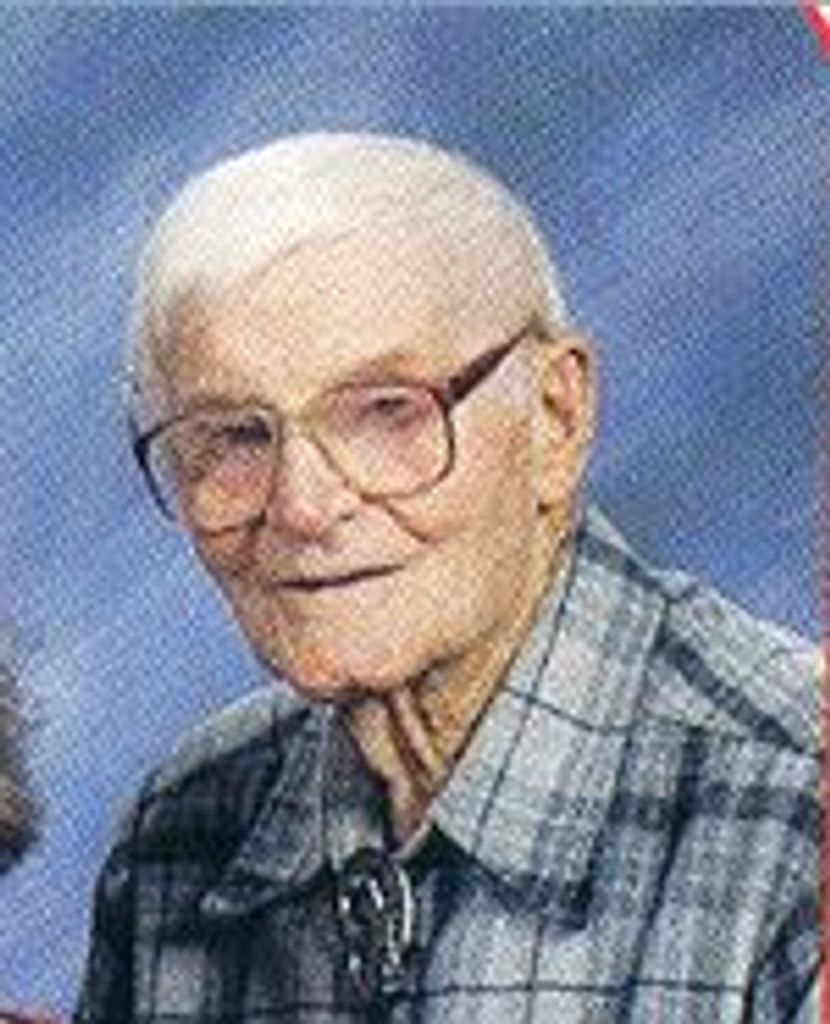
IN LOVING MEMORY OF

Carroll Frederick

Carroll Frederick Eaglesfield Profile Photo

Eaglesfield

Aug 16, 1915 — Aug 3, 2006

Obituary

Carrol Frederick Eaglesfield, 1915-2006

Carrol Frederick Eaglesfield was born in Garden City, Kansas , August 16, 1915 and lived in Oklahoma and Arkansas as a young child. He graduated from Clinton High School in 1933, went on to college at Southwest Baptist College in Bolivar, Missouri ; Texas Christian College ; and graduated from the Universtity of Missouri .

A dedicated hunter, fisher and trapper in his teens, he had fantasies of making a living in Alaska as a big game hunter and guide, but was too sensible to pursue this idea. What he actually planned was a career in pharmacy or medicine and thus he majored in organic chemistry in college. This inclination toward the scientific study of the natural world, and an active personal role in the outdoors never really left him, and returned full force in the 1960s.

But in the 1930s and 1940s his life took a different turn. He heard, and heeded, God's call to the ministry and to the foreign mission field. He took a Doctor of Divinity degree at the Baptist Theological Seminary in Fort Worth , Texas . By then he had already pastored at small country churches in western Missouri , and after finishing seminary he pastored at churches in east Texas and northern Louisiana . While at one of these churches, the Southern Baptist Foreign Mission Board, headquartered in Richmond , Virginia , appointed him to the mission field. By mutual agreement, the particular field was Africa , a good fit for a man who was a natural hunter and who had been deeply dismayed by the racism he had come face to face with in the deep South of the 30s and 40s.

By this time he had a young family, having married Ida Pauline (Polly) Gadberry in 1937. They had a son, George David, born in 1941, and a daughter, Carol Ann, born in 1944. Curiously, both children, like their mother, were called by their middle names their entire life.

In early 1945 the family flew by seaplane to the Azores , then on to Lisbon , Portugal , where they were off-loaded to await transportation south to West Africa . But planes departing Portugal for destinations south and west were scarce in early 1945, since Germans fleeing Europe were paying huge sums to the local airline representatives in Portugal and Spain for seats on planes bound for West Africa and on across to Brazil and Argentina .

Weeks later, the family arrived in West Africa , specifically Nigeria , where Carrol and Polly lived and worked until 1965.

Carrol's first assignment in Nigeria , after six months of language study (Yoruba) and orientation, was to the staff of the Nigerian Baptist Seminary in Ogbomosho (pronounced roughly "oag-BOME-oh-shaw" with the O's sounded about midway between an "OH" and an "AW") in southwestern Nigeria , for it was the policy of the Baptists from the beginning to emphasize the training of Nigerian Christians as school teachers, nurses and church leaders.

Many people do not realize that most missionaries (of all denominations) spend very little time preaching, either from the pulpit or from the shade of the mango tree. Instead, they spend their time establishing schools, seminaries and teaching hospitals. The direct ministry and service to the Africans is thus carried out by the Africans themselves, and eventually the Africans themselves also take over the teacher training colleges, the seminaries, publishing houses and hospitals.

Carrol taught Greek, Hebrew and Old Testament theology at the seminary in Ogbomosho .

Carrol was a very practical man with a mechanical bent. Further, he had worked in a printshop as a teenager. Thus he was soon appointed to head up the fledgling Nigerian Baptist Press in 1947. He established and slowly built up a very organized and efficient publishing house, of course training the African staff to eventually take over as he went along. It wasn't easy. One giant printing press arrived from America in 14 separate crates -- without one word of assembly instructions. Fortunately, there was a single photograph of the assembled machine and that was (barely) enough to get the thing assembled and operational.

He chose the best equipment from America, England and Germany that his l imited budget could afford, and printed millions upon millions of pieces of mostly educational materials. Again to most peoples' surprise, he did not print either bibles or hymn books.

As time passed, the early interests in science and biology resurfaced. Carrol

was transferred to a teaching position in a teacher training college. As a teacher,

he specialized in biology. On his furlough years (usually missionaries in tropical zones spend every fourth year back in the United States ) he picked up a Master of Science from Kansas State College ( Pittsburgh , Kansas ), then came within a whisker of a Ph.D. in zoology from the University of Missouri ( Columbia ), lacking only the completion of a dissertation on the weaver birds of West Africa .

He spent the rest of his mission career teaching biology, including teaching Darwinian evolution as the great unifying theory of all biology -- zoology and botany alike. This did not trouble him at all. If evolution was God's chosen way to populate the earth with all manner of plants and creatures, Carrol Eaglesfield was not about to question the Heavenly Wisdom.

Eventually Carrol and Polly and their third child, John Frederick (who also

wound up being called "Fred" after flirtations with "John" and "John Frederick") retired from the mission field. Back in the States, Carrol taught biology at both the high school and collegiate levels for the next 20 years.

Meanwhile, his personal interests within biology had shifted from zoology to botany. This fit in very well with his lifelong interest in photography. It is a lot easier and more productive to photograph plants than animals, especially for a man increasingly slowed by arthritis in, seemingly, every joint in his body.

After his retirement from this retirement career in the colleges and high schools of Missouri , he took the volunteer route to keeping busy. He joined various botanical and conservationist organizations. His special favorites were the loosely organized Native Plant Societies of whatever locale he settled in: eastern Missouri , western Missouri , out to the state of Washington for several years (where hip replacement surgery gave years of renewed vigor to long hikes far up into the Cascade mountains carrying camera and tripod), and finally back to his high school home in Clinton in western Missouri .

In every town in which he settled he joined the Native Plant Society, often playing a leadership role in the local chapter. At this late point in his life he devoted much of his spare time to photography with good results, though this unfortunately meant the abandonment of other forms of the arts which had given him much pleasure in earlier years. He was a good painter in oils, and played excellent trumpet, french horn, cornet (his personal favorite) and a little saxophone, but nobody who knew him only late in life would ever guess he had ever possessed these talents.

He went on his last field trip in early July, 2006, guiding visitors from the East Coast through some of the glades west of Deepwater to view birds and wildflowers. The pleasure he took from that last outing was a great pleasure for

the visitors from the east to see. The next day, exchanging farewells, he quietly remarked that he felt his life's work was done and that he did not really expect to live out the summer.

Three weeks later he suffered a stroke. Coincidentally, Polly was in the same h ospital recovering from a broken hip. Less than a week after the stroke, Carrol died quietly in Polly's company, a victim of congestive heart failure. His death came ten weeks after his 69th wedding anniversary and two weeks before his 91 st birthday.

He is survived by his wife, Polly, his two sons David and Fred, and a grandson, Mark David Eaglesfield (who goes by his first name).

A memorial service will be held at 11 a.m. on August 10 at the Christian Church in Clinton . Carrol's very strong wishes were that his ashes be scattered on a certain conservation tract of tall-grass prairie in western Missouri and that will be done later this summer.

To send flowers with our preferred florist or plant a memorial tree, please visit our flower store.

Guestbook

Visits: 0

This site is protected by reCAPTCHA and the
Google Privacy Policy and Terms of Service apply.

Service map data © OpenStreetMap contributors